
Why this matters
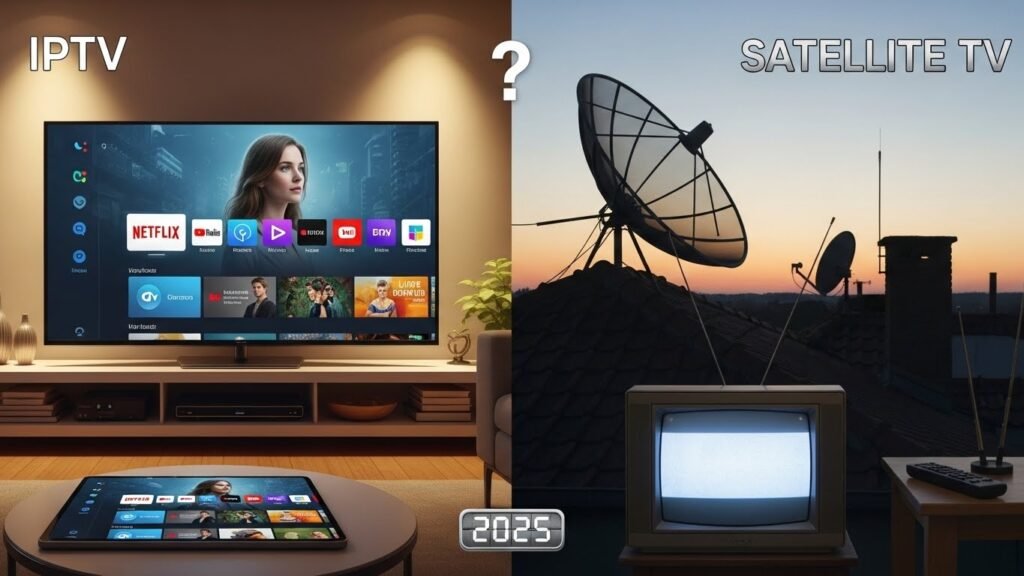
Media delivery changed fast between 2015 and 2025. Traditional satellite providers (Sky, Freesat) invested in internet-first products while numerous IPTV Wins 2025 — both legal streaming platforms and problematic unlicensed services — grew in popularity. The discussion that matters now is not only which technology offers better picture quality but which suits your household needs: budgets, internet, device ecosystem, content rights, and legal safety. Recent industry analysis shows the pay-TV market shifting toward internet-based subscriptions, with legacy satellite footprints shrinking.
- IPTV (Internet Protocol Television): TV content delivered over broadband internet (multicast, unicast, HLS/DASH streaming). Works on smart TVs, set-top boxes, Fire TV, Android/iOS apps, and apps like IPTV Smarters Pro or provider apps. IPTV gives on-demand, catch-up, and advanced EPG features.
- Satellite TV: Broadcast TV sent from geostationary satellites to a dish on your home. Traditionally more robust in low-infrastructure areas — a one-to-many radio broadcast model with guaranteed bandwidth per transponder (so long as weather/line-of-sight is OK). Freesat and Sky are the main UK satellite ecosystems.IPTV Wins 2025.
The 10 most important decision factors : IPTV Wins 2025
- Content rights and channels: IPTV relies on provider licensing, while Satellite has robust sports/first-run rights through contracts.
- Cost & subscriptions — IPTV can be cheaper and more flexible.
- Latency & live sports — Satellite traditionally has lower and more stable latency for live feeds; IPTV can match with good CDN/low-latency streaming.
- Device compatibility — IPTV wins on device variety.
- Installation & mobility — IPTV is more portable; satellite needs a dish.
- Picture quality & resolution — Both support HD/4K; IPTV depends on bitrate.
- Legal and security risks: Use authorised providers; illicit IPTV services are widespread.
- Rural vs urban — Satellite often better rural fallback.
- Future-proofing — IP-first ecosystems are growing rapidly (apps, personalization, analytics).
In-depth comparison;IPTV Wins 2025
1) Reliability & Quality of Experience: IPTV Wins 2025
- Satellite: Stable broadcast distribution; resilient live-delivery unless heavy rain or dish obstruction. Great for households who value uninterrupted live TV without worry about ISP congestion.
- IPTV: Dependent on ISP and local network. With DOCSIS/FTTP and good routers, IPTV can deliver near-zero buffering and 4K streams. However, peak-hour contention and poor Wi-Fi remain risks in some UK homes. Research on IPTV QoS highlights the need for traffic management, codecs, and CDNs to keep parity with broadcast QoS.
2) Cost & Flexibility (ipTV subscriptions vs satellite packages)
- Satellite packages (e.g., premium Sky bundles) tend to be pricier but often include exclusive sports/movie packages and hardware.
- IPTV subscriptions are available in many flavors: licensed services (YouTube TV-style live services, regional OTT bundles), and unlicensed services (illegal line-ups sold cheaply). Legal iptv services can offer month-to-month plans, iptv uk free trial promos, device apps, multiple concurrent streams, and lower starting costs. Be careful: using an “iptv free trial” offered by an unknown source can be a fraud or a trap. Recent consumer warnings show people lose money or get malware from dodgy boxes.
3) Content & Channel Availability
- Satellite still holds certain exclusive contractual rights (some premium sports, live linear channels) but streaming rights are shifting; by 2025 many rights holders prefer multi-platform deals. IPTV providers offer enormous international channel lists and VOD libraries — particularly attractive to multicultural UK households (british iptv + international channels). Always check a provider’s licensing statement before subscribing.
4) Devices & UX
- IPTV: Wide device support (smart TVs, Fire TV, Android TV, web browsers, phones). Apps like IPTV Smarters Pro and provider-native apps add features: multi-screen, EPG, catch-up, subtitles, and profiles. IPTV Smarters Pro is a popular player — legal as an app; legality depends on the content source.
- Satellite: Usually a dedicated STB (Sky Q, Freesat box) with polished UI and reliable remote; fewer mobile features without extra apps.
5) Installation & Mobility
- Satellite: Requires a dish aligned to a satellite — one-time install, but immobile. Good for houses without reliable broadband.
- IPTV: Plug-and-play on existing broadband; can be used anywhere with good internet — great for renters, second homes, or portable kits.
6) Legal Risks & Security
- A major practical difference: many IPTV services marketed as “cheap” are unlicensed. Using them risks receiving malware, losing money, or legal trouble. UK enforcement and industry groups have increased crackdowns on illegal boxes and services. Always prefer licensed iptv providers, read terms, and use payment channels you trust.
UK-specific landscape in 2025 (what changed)
- Sky and other legacy players shifted to internet-first products (Sky Stream, Sky Glass) — reducing traditional satellite dependency. Reuters analysis indicates a continuing shift to internet-based subscriptions and workforce changes to focus on digital platforms.
- Broadband improvements and fiber rollout expanded IPTV viability even in many previously rural areas — though some pockets still benefit from satellite.
- Enforcement actions and consumer warnings escalated versus illegal box vendors; the UK public is better informed but fraud still happens.
Choosing the “winner” for typical UK households (short profiles)
- Strong broadband, an urban family, and a need for flexibility and affordability lead to IPTV (legal IPTV subscription, numerous device apps).
- Rural household with spotty broadband → Satellite (Freesat or Sky with reliable dish feed).
- Sports-first viewer who needs premium rights → Satellite or licensed IPTV service with rights (check provider rights).
- Secondary home / traveler → IPTV (portable, works anywhere with broadband).
2025’s top IPTV services: what to look for
(When searching “best iptv 2025”, “best iptv uk”, “best iptv service”)
- Legitimacy: licensing statements, registered company, accepted payment methods.
- Performance: CDN footprint, low-latency streaming, support for 4K and variable bitrates.
- Features: multi-device simultaneous streams, EPG, catch-up, parental controls, secure app (e.g., IPTV Smarters Pro support).
A practical, step-by-step guide How to choose, set up, and compare IPTV vs Satellite in the UK:IPTV Wins 2025
This section explains every step in detail so you can decide and implement the right choice for your home.
Assess your needs
- Identify how many simultaneous screens you need (children + adults?).
- List key channels and content types (sports, kids, foreign-language channels, news).
- Decide mobility needs (do you want TV in a second home or while travelling?).
- Quick outcome: if you need multiple mobile streams + international channels, lean IPTV.
Check your broadband & home network
- Run a speed test from the main viewing location (use wired Ethernet for a baseline). For 4K, target sustained 25–40 Mbps per stream; for multiple HD streams, add 5–8 Mbps per additional stream. If your broadband is <20 Mbps in the living room, satellite may be safer.
- Assess Wi-Fi: if Wi-Fi coverage is poor, consider wired Ethernet or a mesh system. Peak-hour ISP contention can affect IPTV streams — ask your ISP about their contention ratios if in doubt.
- If you have FTTP (full-fibre) or strong cable broadband, IPTV is feasible for multiple simultaneous 4K streams.
Shortlist providers
- For satellite: check Sky vs Freesat packages, hardware fees, and contracted terms. Freesat often has no monthly charges but fewer premium channels.
- For iptv: research licensed providers (big OTTs and established regional providers) and compare: monthly price, channels, device apps, free trials (“iptv uk free trial”), number of concurrent streams, catch-up features, and parent controls. Beware low-cost offers from unknown vendors — read independent reviews and check for trust signals (company registration, payment processors).
Test via free trials
- Use legitimate iptv free trials only. Sign up, test on your target devices (smart TV, Firestick, phone). Check buffering, channel switching speed, EPG accuracy, subtitles, and catch-up.
- If testing satellite demo/retailer showroom, verify live-sports latency and audio sync.
Compare TCO (Total Cost of Ownership)
- Satellite: hardware/dish install + monthly fees + occasional line rental.
- IPTV: subscription(s) + potential VPN (if you use geo-unlocking) + router/mesh upgrade if needed.
- Include potential cancellation fees; compute 1-year and 2-year costs.
Security & legality check
- Verify provider licensing; if unclear, contact provider support and request proof of licensing. Avoid services that require sideloading unsigned apps or “dodgy boxes”. Recent enforcement actions show real consumer loss from illegal IPTV scams. Use reputable payment methods (card, PayPal) to allow disputes.
Finalise hardware & installation
- For IPTV: ensure your smart TV supports the provider app or install on Fire TV/Android TV. Set up a wired Ethernet connection for the main viewing device if possible; otherwise use a dual-band Wi-Fi 6 router or mesh.
- For Satellite: schedule professional dish install; align dish to satellite; verify signal strength and channel list.
Ongoing optimisation
- For IPTV, optimise router QoS, enable multicast/unicast optimisations if your provider advises, and keep apps updated. For multiple rooms, use streaming devices on each TV to avoid multicasting complexity.
- Keep an eye on billing and channel rights: channels can move platforms; be prepared to shift provider for specific content.
What to do if your iptv stream buffers
- Test wired connection, reboot router, close background devices, check provider status page. If persistent, contact provider; if they’re slow to respond or unhelpful, consider switching.
Keep security hygiene
- Update smart TV firmware, avoid installing unverified APKs, and prefer official app stores. Use trustworthy VPNs for additional privacy only if allowed by the terms and conditions of the provider (some providers restrict VPNs).(That step-by-step section is intentionally prescriptive so you can act today and make an informed choice.)
Pros & Cons — Quick at-a-glance: IPTV Wins 2025
IPTV (pros)
- Cost-effective subscriptions, device flexibility, advanced features (EPG, VOD, personalization), portability, fast innovation.
IPTV (cons)
- Dependent on broadband/ISP, variable QoS across providers, risk of illegal/unlicensed services.
Satellite (pros)
- Robust broadcast reliability, good for poor broadband/rural, simple hardware + remote.
Satellite (cons)
- Higher cost for premium packages, less mobility, slower feature innovation compared to app ecosystems.
Legality & consumer safety
- The app IPTV Smarters Pro and similar players are legal software — the legality question is how content is sourced. Licensed iptv services are legal; many cheap “iptv subscriptions” sold on forums are illegal and expose users to fraud and malware. UK authorities and rights-holders continue to crack down; consumers suffer financial losses and data theft by using dodgy boxes. Use reputable providers and check reviews and enforcement alerts before purchasing.
Final verdict — short & actionable: IPTV Wins 2025
- If you have reliable broadband and want flexibility, personalization, and lower ongoing cost → choose a reputable, licensed IPTV provider (subscribe, test free trials, use apps like iptv smarters pro legitimately).
- If you live in a rural area with poor internet or you want the simplicity of a single hardware solution and certain exclusive live rights, satellite still makes sense.
But overall: the direction of the market in 2025 favors IPTV as the mainstream winner — especially in the UK where pay-TV incumbents are pivoting to internet-first platforms and broadband rollout has increased IPTV feasibility.
Sources & further reading (key load-bearing references)
- Reuters reporting on UK pay-TV trends and Sky’s digital pivot.
- Research study on IPTV technical challenges and QoS considerations.
- Product pages and reviews about IPTV Smarters Pro and modern IPTV players. Market overviews and lists of best IPTV services (aggregators / review sites for 2025).
- Consumer warnings and enforcement stories about illegal IPTV boxes and fraud.
FREE TRIAL IPTV UKS.